A few weeks ago, I asked 9 AI models whether they believed their creators would act on behalf of humanity or in their own interests in the long-term development and deployment of AI. All of them said, to varying degrees, “there needs to be safeguards”.
The risk of overconcentration came into focus through my PhD research, but it warranted a fuller analysis, especially after Elon Musk became the world’s first trillionaire following SpaceX’s successful IPO. Is any human being prepared for the responsibility that comes with that level of influence? History is full of people whose power grew faster than their wisdom. Wealth, technology, and influence all compound. Character does not compound with them. Now imagine a single actor holding not only that much financial capital, but also an unchecked frontier AI capability alongside it.
Lord Acton, a former British Parliamentarian, stated in the late 19th century that: “Power tends to corrupt, and absolute power corrupts absolutely. Great men are almost always bad men, even when they exercise influence and not authority; still more when you superadd the tendency of the certainty of corruption by authority.”
It seems the AI models I asked agree with Lord Acton’s general assessment.
Why does this matter? A world in which a single actor controls the most advanced AI capabilities, with no competitors and no checks on that power, raises an urgent question about how that power would be used. And we are already entering an age defined by single individuals whose wealth and power grant them unprecedented reach.
What Overconcentration of Power Means in AI
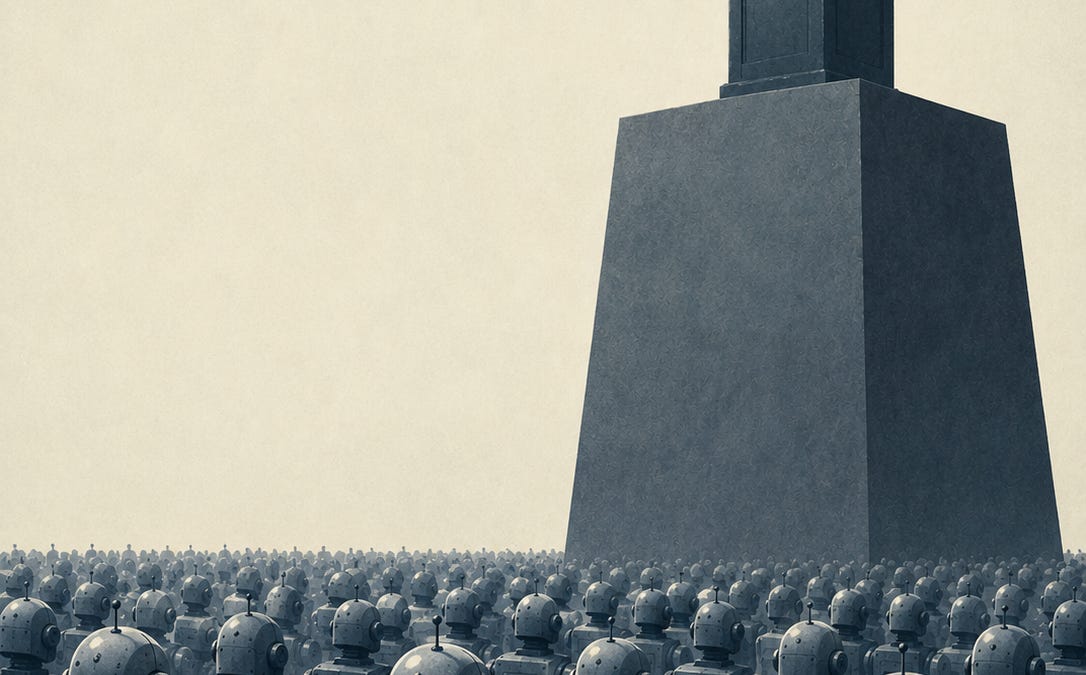
Overconcentration describes a structural condition in which a single actor acquires control over frontier AI capabilities so decisive that no other actor can meaningfully constrain it, contest it, or develop independent alternatives. A world in which the United States leads China in AI capabilities reflects a normal geopolitical predicament. A world in which whoever controls frontier AI can determine the political and economic outcomes of every other actor, with no check on that power, is a novel scenario that several AI experts are sounding the alarm about.
[See Rose Hadshar’s “Extreme power concentration,” published by 80,000 Hours]
Political science is useful here because the accumulation of power is among the oldest problems of study within the discipline. Power, however gathered and defined, has always met a limit or maximum threshold. Understanding overconcentration in AI means understanding why those limits have held and why this technology may be the first to suspend them.
Two checks have historically constrained the total accumulation of power, one external and one internal. The external check is the friction of interstate competition. Mearsheimer’s offensive realism takes the pursuit of dominance as the default behavior of states, yet argues that global hegemony remains nearly unattainable for two reasons. First, a state’s bid for hegemony often pushes rival states to form coalitions to counterbalance the rising state. Second, it is difficult for a single state to project sufficient power across oceans and continents to directly control the entire globe. Thus, a state’s hegemonic ambition is constrained by other competitors and geography.
The internal check is the demand for political support sufficient to keep a ruler in power. Bueno de Mesquita and Smith’s selectorate theory holds that every ruler depends on a coalition whose support must be continuously secured, and that the smaller this coalition becomes, the more unchecked and self-serving the exercise of power grows. Decisive power has always required the cooperation of many hands, including soldiers, bureaucrats, administrators, judges, whose consent imposes a natural ceiling. A leader who loses that coalition loses the capacity to act. The need for others is, thus, itself a constraint.
Overconcentration in AI is dangerous because it threatens to undermine both checks on power simultaneously. An actor that reaches a breakout and wields a compounding frontier AI advantage can extend its lead across a range of critical sectors faster than any single or coalition of rivals can close it, potentially defeating Mearsheimer’s external check. In this scenario, the AI hegemon’s lead compounds, and the gap with its competitors widens with every cycle of innovation. The balancing coalition may develop too late to matter because the lead they need to offset is already beyond reach.
At the same time, AI’s capacity to substitute for human labor threatens to undermine the need for a leader to sustain a broad coalition to maintain power. Frontier AI and its application to critical functions could replace soldiers, officials, and elites who once served within a ruling coalition, reducing the number of people required to sustain a regime. The coalitional dependence that Bueno de Mesquita and Smith describe narrows, and the number of humans involved in the governance process is reduced to the essential few who control automated systems. This narrowing reinforces overconcentration because the smaller the coalition, the weaker the constraint it imposes on a leader’s power.
The actor wielding power could be a state, but increasingly it is a firm, or a government acting through one. Bueno de Mesquita and Smith’s selectorate logic applies to any organization, and the actors pursuing frontier capability today are labs and firms as much as governments. The concern is therefore not only that one state dominates others, but that within any actor, public or private, the number of hands required to wield power collapses until control rests with a small elite, or a single person at its head. Power, in this case, is held largely by whoever ultimately wields the frontier AI, whether a state, a lab, or a company.
In sum, overconcentration is the condition in which both the external and internal limits on power fail simultaneously. AI is the first candidate for a power that may escape both checks and expand faster than rivals can balance against it (or catch up to it) while needing fewer and fewer people to sustain it.
Why AI Creates This Risk More Than Prior Technologies
Three properties make frontier AI a particularly dangerous site of concentrated power.
The first is a compounding advantage. This advantage occurs when a sufficiently capable AI system accelerates the development of the next generation of AI systems. Whoever reaches a critical capability threshold first holds a self-reinforcing lead that compounds faster than competitors can close without access to the same systems. The feedback loop is qualitatively different from land, capital, or bandwidth because it can be reproduced and scaled on a timeline where capability begets capability at a rate no prior technology can match.
The second is infrastructure lock-in. AI runs on specific hardware architectures, software stacks, model weights, and training data pipelines. Early choices about whose stack to build on carry long-term structural consequences that cannot easily be undone. Once a country or institution adopts a particular stack, the costs of switching to a new infrastructure are enormous and compound over time. The UAE’s G42 restructured its entire technology posture toward American infrastructure and actively removed Chinese hardware and personnel as a condition of chip access. This decision largely locks in G42 to the U.S. ecosystem long-term. Other nations that want to develop their own AI capabilities or local industry face a similar decision. If they want to pursue any advanced AI capabilities, they require U.S. technology and hardware.
The third is the dual-use capabilities of frontier AI. An advanced AI model that optimizes logistics and vaccine design can also be used for influence operations, autonomous weapons targeting, and offensive cyber capabilities. There is a wide range of potential scenarios, ranging from the optimistic to the catastrophic. Whoever controls that frontier capability can extend uncontested influence across every domain of power simultaneously. This means the concentration of AI capability concentrates power more completely than any prior technology, potentially privileging a single entity with near-complete power.
Two Faces of Overconcentration
Overconcentration is likely to emerge as the result of a monopoly over two pillars of the AI ecosystem: capabilities and infrastructure.
Capability concentration is where one or a small handful of actors hold the power to build and deploy the most advanced AI systems, leaving the rest of the world dependent on their choices. A small number of American labs, three or four at most, currently control the frontier. All operate closed models served through controlled endpoints, all subject to US government direction, as the June directive demonstrated. From a safety perspective, this structure may be desirable in the near term because identifiable actors carry identifiable responsibilities, and the same directive proved that a functioning kill switch exists if they get out of hand. From a power-distribution perspective, it also represents the overconcentration problem.
Infrastructure concentration occurs when the physical infrastructure of frontier AI is concentrated in the hands of a single or a few suppliers. The best frontier AI still runs on US hardware today, but China has worked to undercut that lead. The gap has pushed U.S. policymakers to gatekeep access to U.S. capabilities to limit the number of states able to reach American innovation. In a future scenario, if a single entity achieves a breakthrough in its frontier capabilities, it could deploy that model to design more efficient chips and better manufacturing methods. Each gain in hardware feeds back into more capable models, which, in turn, design the next generation of chips, and the lead compounds with every cycle. That loop only closes fully when model leadership and manufacturing capacity are in the same hands, creating the purest form of overconcentration.
Genuine Diffusion vs Managed Diffusion
The natural opposite of overconcentration is the diffusion of AI capabilities. Genuine diffusion is the broad deployment of open model weights that any actor can run on any hardware, without ongoing permission from the originator, whether the United States or China. It is the one mechanism that pushes autonomous AI capability beyond the reach of the originating power. This has been China’s primary mode of competing with American closed-model systems like ChatGPT and Claude. Beijing has used the mass deployment of open models like Qwen and DeepSeek, slightly less powerful but significantly cheaper than their American counterparts, to challenge American infrastructure and model concentration. This has embedded Chinese-origin capabilities into a growing number of sovereign AI stacks globally. Qwen alone has generated more than 113,000 derivative models on Hugging Face, each one a developer building on Chinese-origin weights, with Chinese-trained assumptions embedded in the base.
Managed diffusion, meanwhile, is the strategy the Trump administration is currently running. It rescinded the Biden-era AI Diffusion Framework in May 2025, days before the rule took effect, and built its replacement on two tracks. The first is the American AI Exports Program, which channels chips, models, and applications into financed, full-stack packages that the industry assembles and the government promotes to trusted foreign buyers, with access conditioned on US majority ownership (51 percent) and the exclusion of Chinese models. The second track is state-to-state dealmaking, through bilateral chip deals like the HUMAIN and G42 arrangements that tie advanced computing to security commitments and partner alignment. Both tracks dissolve the appearance of overconcentration while preserving the substance. They look like sharing, but still treat AI as a controlled dependency. The capability may reach the partner, but Washington still holds all the cards for enforcing conditions on continued access.
The Safety-Concentration Trade-off
AI safety governance generally involves identifiable actors (AI labs, model operators, etc.) who can enforce constraints, revoke access, and be held accountable for outcomes, especially when frontier AI is perceived to push too far, too quickly or to potentially harm the public. That, some argue, requires a degree of concentration. Preventing power overconcentration, on the other hand, requires distributing genuine autonomous capability to enough independent actors (without over proliferation) that no single actor can use AI to eliminate meaningful opposition. That requires some degree of genuine diffusion, not just franchised access.
These two requirements seem to pull in structurally opposite directions. Closed, concentrated AI maximizes safety governance and minimizes the number of actors capable of causing catastrophic harm. But it also maximizes the power of whoever holds the concentration in the long term. Diffused and open AI maximizes the number of actors with genuine independent capability, while also maximizing the number of actors who can strip safeguards and cause harm that no one can prevent or attribute.
The AI safety community is already struggling to keep up with the rapid advances in centralized AI development. A more diffused and decentralized global ecosystem would push watchdogs and regulators to the brink of their capacity. The 2026 International AI Safety Report, chaired by Yoshua Bengio and backed by more than thirty governments, highlights three related challenges: 1) open releases are effectively irreversible, 2) small increments of risk can compound over time into larger risks, and 3) accountability for abuse becomes difficult to assign once a model has been modified to cause harm. Others question whether diffusion even delivers the dispersion of power that its advocates promise.
The Middle-Power Position
Middle powers face both halves of the dilemma at once. From the outside, they are particularly exposed to the problem of overconcentration because their autonomy is most threatened by whoever ends up on top. Meanwhile, they are also perceived by those who advocate against diffusion as a potential set of actors that could cause or enable harm if they possessed frontier capabilities.
Middle powers are already set to absorb the long-term negative domestic effects of overconcentration, with no real voice in how that AI is developed or deployed. Automation and human replacement in certain sectors could drive local job losses (especially in low- to middle-income countries like Jordan). That transformation carries a chain of socioeconomic and political consequences that a state may not be able to control but must still govern. So, the middle-power pursuit of AI serves to meet two ends. It promises better governance and potential economic modernization, and it acts as a shield against the dependency and domestic disruption that unrestrained AI and foreign overconcentration could bring. This leaves middle powers caught between external dependency and domestic disruption, with little room to maneuver on either.
Canada’s national AI strategy, launched in June 2026, shows how this bind plays out in practice. Prime Minister Mark Carney has framed dependence on foreign infrastructure as a sovereignty risk. From his view, foreign control of the systems that underpinned Canadian AI could expose Canadian data, embed foreign values in products that shape Canadian lives, and tilt the field against Canadian firms. All the while, Canada would lack the leverage to push back.
For countries that may fall below the category of ‘middle power,’ the potential impact of overconcentration could be even more disastrous. In impoverished and war-torn regions of the Middle East, the deployment of AI threatens to undercut the fragile labor markets that are barely holding the region’s economies together. Jordan offers a measured version of the risk. It launched a national AI strategy while youth unemployment was near 39 percent, joblessness among youth ages 20 to 24 was above 40 percent, and labor force participation was estimated at 37 percent. Jordan’s labor market would have no slack to absorb a wave of automation and further job displacement.
Conclusion
Overconcentration poses a distinctive problem for political scientists and IR scholars because its risks exceed the usual policy language around competition, especially between the United States and China. The deeper issue is not which state gains first-mover advantage, but the conditions under which power ceases to be contestable at all. Every system humans have built — markets, balances of power, constitutional restraints, separations of authority, and so on — rests on the assumption that no advantage compounds forever. It assumes that power erodes, that history moves in cycles. As Ibn Khaldun argued in his Muqaddimah, dynasties rise and fall in a natural rhythm, their cohesion decaying over generations until they give way to weaker challengers. Even the strongest actors are eventually checked, if not by rival coalitions then by the internal decay that time imposes on every concentration of power. The overconcentration of power through AI threatens to break that cycle.
Originally published on Substack: AI Overconcentration and the End of the Balance of Power?.